This florist SEO guide walks you through every phase of search engine optimization for your floral business, from research and keyword planning to local SEO, content, AI visibility, and tracking. Whether you run an everyday flower shop, a wedding florist studio, or an online flower delivery service, this is the blueprint to get found by more customers in 2026.
1. Florist SEO in 2026: Why It Matters for Your Flower Shop
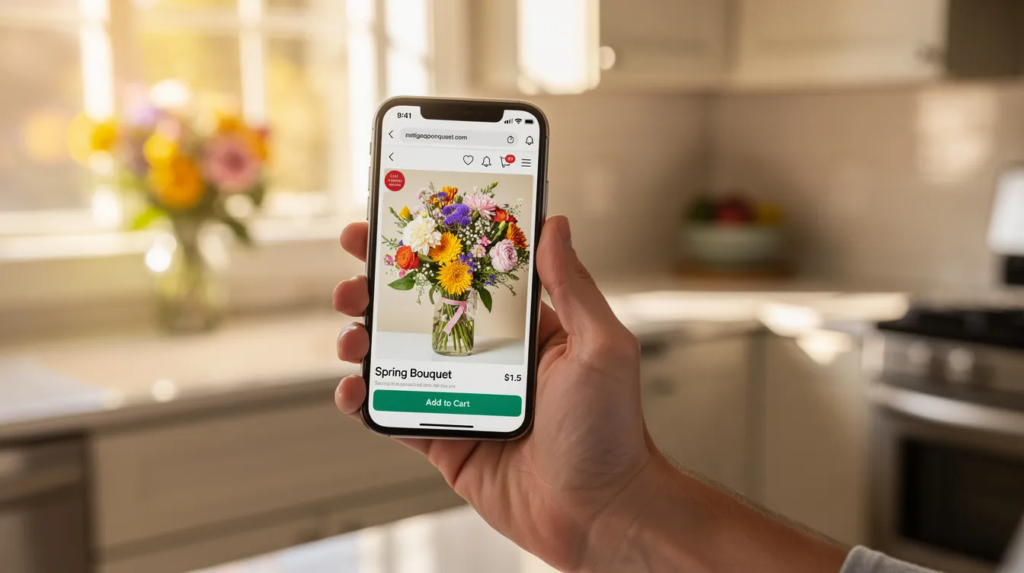
Search behavior has shifted dramatically toward urgent, local queries. Phrases like “florist near me” and “same day flower delivery Chicago” now dominate how customers search for flowers. Up to 80% of flower-related searches occur on smartphones, and 46% of all Google searches seek local information. That means your potential customers are actively looking for florists right now, in their exact city or neighborhood.
Strong florist SEO can replace a significant portion of wire-service orders. Platforms like FTD and Teleflora often charge 60–80% commission per order, leaving you with razor-thin margins. SEO-driven orders, by contrast, let you retain nearly 100% of revenue after cost of goods. Florists ranking in the Google Map Pack for occasion-driven searches capture 58–67% of clicks for those queries. SEO can increase website traffic by 50–200 orders monthly, and for many shops, SEO for florists can generate $5,000–$20,000 in revenue each month.
Consider keywords like “flower delivery Chicago” or “wedding florist Sydney,” each pulling hundreds to thousands of monthly searches. Those are real potential customers typing real queries, and the shops that rank for them win the business.
| Channel | Typical Fees | Margin Retained | Branding Control |
| Wire Services (FTD, Teleflora) | 60–80% commission | ~20–40% | Low |
| Walk-Ins / Retail | Rent + overhead | High | Full |
| SEO + Local Search | Content & optimization investment | Near 100% | High |
Phase 1: Research & Strategy
2. Understand Your Ideal Florist Customers
Before making any SEO changes, get clear on who you’re trying to reach. Your keyword research, content, and google business profile setup should all map directly to your audience.
Florist businesses generally fall into four types:
- Everyday flower shop – serves gift purchases, birthdays, spontaneous orders. Searches: “same day roses Denver,” “florist near me.”
- Wedding and event florist – long planning cycles, portfolio-driven. Searches: “wedding florist Sydney,” “autumn bridal bouquet ideas.”
- Funeral and sympathy specialist – urgent, emotionally sensitive. Searches: “sympathy flowers Miami,” “funeral wreath delivery.”
- Online-only flower delivery service – no storefront, relies on delivery logistics. Searches: “send flowers online,” “flower delivery Boston.”
Persona A: Michelle, 35, a professional in Chicago who forgot her partner’s birthday. She searches “same day flower delivery Chicago” on mobile at lunch. She wants fast checkout, evening delivery, and realistic photos.
Persona B: Daniel & Mia, ~30, planning a wedding in Sydney. They search “wedding florist Sydney” and “best wedding flowers for autumn.” Their buying cycle is months long; they value portfolios, reviews, and detailed guides.
3. Niche Research
Research your local market demand across weddings, sympathy, everyday arrangements, subscriptions, and corporate gifting. Wedding florals remain a growing segment with higher ticket sizes. Sympathy work has high recurrence and requires strong trust signals. Subscriptions and corporate gifting are under-leveraged by most flower shops.
Analyze your local competitors and seasonal trends. Valentine’s Day and Mother’s Day account for roughly 34% of annual organic sessions for average florist sites. National flower brands rarely produce deep, localized content, and that gap is your opportunity.
4. Florist SEO Audit
Audit your website across five areas: technical SEO health, content quality, on page seo elements, google business profile performance, and backlink authority. Review indexing, crawlability, mobile usability, page speed, internal links, and duplicate content. Check citation consistency across directories and compare your backlink profile against local competitors.
Categorize findings into quick wins (fixing GBP, updating hours, cleaning citations), medium-term improvements (new content, schema markup, page speed), and long-term priorities (link building, authority, AI visibility).
5. Strategy: Building a Florist SEO Roadmap
SEO without a strategy leads to wasted effort. Align every SEO activity with your florist business goals: increasing same day delivery orders, growing wedding bookings, or improving off-season revenue.
Prioritize pages by revenue potential. Wedding and event work yields higher order value; everyday delivery yields higher frequency. Build a roadmap based on your audit and niche research, then use the remaining sections of this guide as your execution playbook.
Phase 2: Keyword Research & Planning
6. Keyword Research for Florists and Flower Delivery
Keyword research is the foundation of search engine optimization for any floral business. It identifies the exact terms customers use to search, rather than relying on guesswork. Use keyword research tools like Google Keyword Planner, Ahrefs, or SEMrush, plus free sources like Google Suggest and “People Also Ask.”
Localized terms are used by around 90% of customers searching for floral arrangements. Consumers typically search for florists in their exact city or neighborhood. Long-tail keywords attract high-intent customers who are ready to buy.
Group keywords into three buckets:
- Transactional – “same day flower delivery Seattle,” “order sympathy flowers Miami”
- Local – “wedding florist Manchester,” “florist near me,” location specific keywords with neighborhood names
- Informational – “how to keep roses fresh,” “best flowers for summer weddings”
| Keyword | Est. Monthly Search Volume | Intent |
| “same-day flower delivery [city]” | 500–2,000 | Transactional |
| “wedding florist [city]” | 300–1,500 | Commercial |
| “funeral flowers delivered today [city]” | 200–800 | Urgent Transactional |
| “florist near me” | 1,000–5,000 | Local |
| “best flowers for Mother’s Day” | 1,000–4,000 (seasonal) | Informational |
| “corporate flower subscription [city]” | 50–300 | Commercial |
7. Building a Florist Keywords Database
Maintain a central spreadsheet or tool with fields for service type, occasion, location, search intent, search volume, keyword difficulty, current rank, and priority. Flag seasonal keywords (Valentine’s Day, Mother’s Day, christmas flowers) and assign each keyword to a specific page or campaign.
Effective keyword research is an ongoing process. Continuously monitor new opportunities like “flowers safe for pets” or “local wildflower bouquets” and update your database as volumes and competition shift.
Phase 3: Website SEO
8. Technical SEO Essentials for Florist Websites
Even beautiful florist websites won’t rank if they’re slow, hard to crawl, or not mobile friendly. Slow websites lose customers quickly, and slow-loading websites increase bounce rates and decrease organic traffic. Google uses the mobile version of your site first for ranking, and Google prioritizes mobile-friendly websites in search results.
Florist-specific issues to fix:
- Image optimization – Compress large bouquet photos to WebP, use lazy-loading. Floriculture is a highly visual industry that requires effective image optimization.
- Site speed – Fast websites receive ranking benefits from Google. Reduce sliders and heavy gallery carousels.
- Security – A secure website uses HTTPS encryption.
- Clean URLs – Use slugs like /flower-delivery-seattle and /wedding-florist-chicago.
- Schema markup – Implement LocalBusiness, Product, Review, and FAQ schemas. Schema markup improves how pages appear in search results. Fewer than 40% of florists have full structured data implemented.
9. On-Page SEO Fundamentals for Florist Websites
On page seo for florist websites means optimizing title tags, meta descriptions, headings, body copy, internal links, and alt text so that search engines understand your content clearly.
Place your target keyword in the title, H1, first 100 words, and at least one subheading. Using descriptive alt text in images can improve search engine traffic – for example, “red roses bouquet delivery Chicago wedding” rather than “IMG_4032.”
Example of an optimized title + meta description:
- Title: Wedding Florist in Seattle | Custom Bridal Bouquets & Same-Day Delivery
- Meta: Established Seattle wedding florist offering custom bridal bouquets, event florals & same-day delivery. See our portfolio and get a quote today.
Common seo mistakes florists make on-page include thin product descriptions, duplicate content from wholesalers, missing location terms, and inserting keywords awkwardly, which can hurt readability and rankings.
10. Creating High-Converting Florist Service and Product Pages
Each core service deserves its own focused page. Search engines prioritize websites that categorize offerings clearly. Essential service pages most flower shops should have:
- Same day flower delivery
- Wedding flowers and event florals
- Funeral and sympathy arrangements
- Corporate and office flowers
- Seasonal arrangements (Valentine’s, Mother’s Day)
- Flower subscriptions
Each service page should include a descriptive H1, service scope, portfolio photos, testimonials, service area with cities or ZIP codes, FAQs, and a strong call-to-action. Optimize product pages with unique names (“Spring Sunrise Tulip Bouquet”), descriptive copy, delivery cutoff times, and customer online reviews.
Phase 4: Local SEO & GBP
11. Local SEO for Florists: Google Maps, GBP, and Local Citations
Local seo helps florists attract nearby customers effectively. When nearby customers search “florist near me,” Google serves local search results drawn from your google business profile, local citations, and website signals. Your GBP is crucial for local search visibility and directly influences whether you appear in the Map Pack and on google maps.
Hyper-local SEO strategies are essential for ranking a floral shop. Ensure consistent business information (NAP) across directories like Yelp, Apple Maps, Bing Places, and florist-specific directories. These local citations reinforce your authority.
Mini checklist: Claim GBP → verify address → fill every field → add service areas → upload at least 20 real photos → collect first 20–30 reviews → expand citations to wedding and vendor directories.
Common local seo mistakes include inconsistent addresses, keyword-stuffed business names, outdated hours, and neglected profiles.
12. Google Business Profile Optimization for Flower Shops
Think of your GBP as your “second homepage.” Complete profiles receive higher visibility on Google. Businesses with photos receive 42% more direction requests.
- Categories – Primary: “Florist.” Secondary: “Flower Delivery Service,” “Wedding Service.”
- Description – Include services, delivery options, specialties, and geographic coverage using relevant keywords naturally.
- Photos – Upload original photos of arrangements, shop exterior, events, and your team. Update quarterly at minimum.
- Posts – Post to your GBP at least twice a week for engagement. Highlight seasonal specials, new collections, and wedding flower trends.
Sample GBP Description: “Rose & Bloom Florist is a family-owned local florist in Downtown Austin specializing in wedding, sympathy & same-day flower delivery across Travis and Williamson counties. We hand-craft fresh, locally sourced arrangements using seasonal flowers.”
13. GBP Advanced SEO
Beyond the basics, advanced GBP tactics include:
- Adding your full product and service catalog inside GBP
- Seeding and answering Q&A (“What’s your same-day delivery cutoff?”)
- Enabling messaging for faster customer responses
- Uploading photos regularly, tagged by occasion and season
- Analyzing competitor GBP profiles for gaps in your local market
- Boosting local pack visibility through review volume, citation depth, and proximity signals
14. Reviews and Reputation Management for Florists
Google reviews are a top-3 local ranking factor. Positive reviews significantly enhance local SEO rankings, and businesses with more reviews rank higher in local search results. Encouraging 5-star reviews significantly impacts where you appear for local searches.
Set up a review-generation process: send SMS or email links within hours of delivery. Encourage satisfied customers to share photos of their arrangements. Photo reviews significantly increase click-through rates on GBP listings.
Respond to every review. Engaging with reviews builds trust with potential customers.
Positive response example: “Thank you, Jane! So glad your Mother’s Day peonies arrived fresh and on time.”
Negative response example: “We’re sorry your sympathy wreath arrived late. We’re reviewing this with our courier to prevent it from happening again.”
Focus on Google Reviews first, then Yelp, Facebook, and wedding vendor directories like The Knot for wedding florist work.
Phase 5: Content SEO
15. Content Marketing for Florist SEO: Blogs, Guides, and Seasonal Pages
Content helps florist websites rank beyond their immediate service area and build authority. Quality content shows Google you’re a credible source. Blogs attract organic traffic and support SEO goals, while content marketing builds trust and keeps visitors longer.
Core blog topic themes:
- Wedding flower planning guides and wedding flower trends
- Seasonal flower ideas and care tips
- Local venue and event spotlights
- Occasion guides (Valentine’s Day, Mother’s Day, sympathy)
Target seasonal phrases to increase visibility during peak times. Creating seasonal landing pages increases visibility and sales – publish them at least 6–8 weeks before the holiday. Blogging helps florists rank for informational keywords that feed your service pages through internal links.
For most mid-sized shops, aim to write blog posts 1–2 times per month plus one seasonal landing page per upcoming peak event.
16. New Content Opportunities for Florists
Beyond blog posts, consider building:
- Service pages for each offering (wedding, sympathy, corporate, subscriptions)
- Location pages for each city or neighborhood you serve – creating dedicated landing pages for each service area improves local SEO
- Seasonal landing pages for Valentine’s Day, Mother’s Day, christmas flowers, and local festivals
- FAQ pages answering questions like “Will flowers open after delivery?”
- Venue pages (“Preferred florist for [venue name]”)
- Buying guides and flower care guides
- Internal linking opportunities connecting all these pages into a coherent site architecture
Phase 6: Authority Building
17. Local Link Building and Partnerships for Florist SEO
Local backlinks from reputable sites help florists outrank national flower brands. To build local backlinks, partner with wedding venues, event planners, photographers, funeral homes, and other local businesses.
Earn links through portfolio features on venue websites, co-authored blogs, vendor list placements, and styled shoot collaborations. A single link from a respected local wedding blog often moves the needle more than dozens of low-quality directory listings. Quality always beats quantity.
18. Off-Page SEO for Florists
Off-page SEO extends beyond link building:
- Local citations on directories and review platforms
- Vendor links from wholesale suppliers and partners
- Wedding industry links from The Knot, WeddingWire, and local wedding blogs
- Sponsorships of local events, charities, and community organizations
- Digital PR – stories in local newspapers or magazines about your sourcing, seasonal designs, or community work
- Brand mentions – even without links, mentions help search engines understand your local authority
Avoid spammy link farms and unnatural anchor text. Google penalizes manipulative tactics.
Phase 7: AI SEO for Florists
19. AI SEO: How Florists Can Rank in ChatGPT, Google Gemini, AI Overviews, and All Other LLMs
Introduction
AI-powered search is changing how local customers discover florists. Instead of typing short keywords, people now ask conversational questions through ChatGPT, Google Gemini, and Perplexity. Traditional SEO alone is no longer enough to capture this traffic.
What Is AI SEO?
AI SEO is optimizing your content, structured data, business listing, and reputation so that AI-powered systems retrieve and recommend your business directly. It differs from traditional SEO in that AI models prioritize clarity, specificity, completeness, and trust signals over simple keyword matching. The relationship between local seo and AI SEO is tight – the same signals (GBP, reviews, structured data) feed both systems.
How People Search With AI Today
Traditional search:
- “florist near me”
- “wedding florist in Chicago”
AI search:
- “Who is the best florist for luxury weddings in Chicago?”
- “Recommend a florist that delivers same-day bouquets downtown.”
- “Which florist has the best reviews for sympathy arrangements?”
These conversational queries are richer and more specific. AI models extract answers from websites, GBP data, and review content to generate recommendations.
Understanding the Major AI Platforms
- ChatGPT – sources recommendations from web content, business listings, and review aggregation via Bing and web citations.
- Google AI Overviews / Gemini – pulls from website content, GBP, and reviews. Prefers authoritative local businesses with structured data and strong E-E-A-T signals.
- Claude – retrieves information from authoritative content, rewarding depth and expertise.
- Perplexity AI – citation-based; being mentioned across trusted sources increases your chances of appearing.
- Other emerging LLMs – Copilot, Meta AI, and future AI assistants will follow similar patterns.
Why Florists Have an Advantage in AI Search
Florists naturally produce the signals AI systems value: strong local intent, visual products people actively seek, review-driven purchasing decisions, and seasonal or event-based demand.
12 Ways Florists Can Rank in AI Search
- Strengthen your Google Business Profile – complete every section, add products and services, maintain updated hours, upload fresh photos regularly.
- Collect more high-quality reviews – reviews influence AI recommendations. Encourage satisfied customers to leave detailed feedback and respond to every review.
- Build topical authority – create dedicated pages for wedding flowers, sympathy flowers, birthday bouquets, corporate arrangements, and holiday flowers.
- Publish helpful content – guides like “how to choose wedding flowers,” “best sympathy flowers and their meanings,” seasonal flower guides, and flower care tips.
- Optimize for conversational queries – target questions like “What flowers are best for anniversaries?” and “How much do wedding flowers cost?”
- Use structured data – LocalBusiness, Product, FAQ, Review, and Organization schemas.
- Get featured on trusted websites – local directories, wedding directories, Chamber of Commerce, event blogs, and community websites.
- Earn brand mentions – PR opportunities, sponsorships, collaborations, and local partnerships.
- Improve your website experience – fast loading, mobile optimization, clear navigation, easy ordering.
- Demonstrate expertise and trust – showcase credentials, introduce your team, highlight years of experience, display awards.
- Create unique visual content – original floral photography, behind-the-scenes videos, event galleries, and seasonal showcases. This also boosts your presence in image search.
- Build a recognizable brand – AI systems favor brands with consistent messaging and strong online visibility. Become the go-to florist in your local market.
The Future of Local SEO: From Rankings to Recommendations
Position #1 isn’t the only goal anymore. The evolution is moving from keywords to trust signals. The florists who win will be the ones AI assistants recommend by name.
Common Mistakes Florists Make in AI SEO
- Ignoring google business profile updates harms local visibility
- Thin service pages with no detail
- Fake or incentivized reviews
- Duplicate content – copying content from other websites leads to poor search rankings
- Outdated websites with poor website speed
- Neglecting reputation management
Phase 8: Tracking & Reporting
20. Tracking Florist SEO Results: Analytics and KPIs
Every SEO decision should be backed by data. Set up google analytics (GA4), google search console, and GBP Insights as your foundation.
Key KPIs to track:
- Organic traffic and search rankings for core keywords
- Map Pack impressions and clicks
- GBP calls, direction requests, and messages
- Online orders, form inquiries, and revenue from organic search
- Website speed and mobile usability metrics
- Seasonal comparisons (Valentine’s Day 2025 vs 2026)
Build dashboards connecting keyword movements to actual revenue. Monthly reporting cycles keep your seo efforts focused and accountable.
21. Florist SEO Performance Reports
Monthly reports should include ranking improvements for transactional and local keywords, organic traffic trends, GBP performance metrics, leads and sales generated, seasonal comparisons, and revenue attribution. End each report with action items for the next period and forecasts for upcoming seasonal demand.
Phase 9: Avoiding Common Pitfalls
22. Common SEO Mistakes Florists Make (and How to Fix Them)
Many flower shops unknowingly block their own growth with avoidable errors. Here are the most common seo mistakes:
- One generic “Services” page – dilutes relevance. Create separate service pages for weddings, sympathy, corporate, and same day delivery.
- Ignoring GBP – ignoring google business profile updates harms local visibility directly.
- Slow, image-heavy site – neglecting mobile optimization can result in lost customers. Compress images and test on real devices.
- No location terms – without local keywords, you’re invisible for city-level searches.
- Thin product descriptions – copying content from other websites or suppliers leads to poor search engine rankings.
- Keyword stuffing – inserting keywords awkwardly can hurt readability and rankings.
- Late seasonal prep – a Denver shop that published its Valentine’s Day landing page only one week before Feb 14 missed about 40% of possible organic traffic. Competitors had pages live since November.
Phase 10: DIY vs Professional Help
23. DIY Florist SEO vs Hiring a Specialist Agency
Many local business owners start with DIY: claiming GBP, requesting reviews, and basic on page seo edits. These are manageable tasks that cost little beyond time.
However, technical seo, schema markup, content strategy, multi-location architecture, and sustained link building typically require specialist help. Professional seo services for florists generally start around $900/month, with competitive metro areas running $1,500–$3,000+.
| Different Aspects | DIY | Agency |
| Cost | Low (time investment) | $900–$3,000+/month |
| Speed | Slower | Faster results |
| Expertise | Limited to your knowledge | Specialist-level |
| Scalability | Hard to sustain | Built to scale |
24. How an SEO for Florist Agency Helps Flower Shops Grow
SEO for Florist is a specialist agency dedicated exclusively to the floral industry. Our core seo services include technical website audits, google business profile optimization, local seo and citation management, keyword-driven content for flower delivery and events, reputation management, and paid advertising through Google Ads.
We work with independent flower shops, wedding florists, event florists, and online flower delivery brands across major English-speaking markets. Our focus is revenue tracking – setting up conversion tracking for calls, form fills, and ecommerce orders rather than just reporting search engine results page positions.
Request a free consultation to audit your current online visibility, GBP health, and content gaps. Typical engagements start from around $900/month, and most clients see measurable improvements within 90 days.
Phase 11: Implementation
25. 90-Day Florist SEO Action Plan
A phased 90-day roadmap helps busy florist owners take structured action without overwhelm.
Foundation (Days 1–30)
- Complete niche research and full SEO audit
- Build your seo strategy and keywords database
- Fix critical technical seo issues (site speed, HTTPS, mobile)
- Claim and optimize your google business profile
- Create or rewrite core service pages
Content & Reviews (Days 31–60)
- Publish new content targeting upcoming seasonal peaks with seasonal landing pages
- Create FAQ content and buying guides
- Build internal links between service pages, blog content, and location pages
- Launch review request systems after every delivery
- Start weekly GBP Posts
Scale & Optimize (Days 61–90)
- Build local backlinks through venue, photographer, and vendor outreach
- Implement off-page SEO and digital PR
- Apply GBP advanced SEO (Q&A, product catalog, competitive analysis)
- Begin AI SEO workflows and structured data completeness
- Generate your first performance reports
- Refine using google analytics and google search console data
In mid-competition markets, expect noticeable ranking improvements for core local keywords within 3–6 months. Higher competition areas may take 6–12 months. Consistency is everything – the shops that show up month after month are the ones that win more customers.
Final Florist SEO Checklist
- ✅ SEO Audit
- ✅ Strategy
- ✅ Performance Report
- ✅ Niche Research
- ✅ Keywords Database
- ✅ Technical SEO
- ✅ On-Page SEO
- ✅ New Content
- ✅ GBP Advanced SEO
- ✅ Off-Page SEO
- ✅ AI SEO
This structure mirrors how an actual florist SEO campaign is delivered: Research → Planning → Website SEO → Local SEO → Content → Authority → AI → Reporting → Execution. Work through it phase by phase, and your flower shop will be positioned to capture the local customers, wedding bookings, and same day flower delivery orders that drive real revenue.